

1000V vs 1500V MC4 Connectors: How Voltage Ratings Affect Your System Design?
1000V vs 1500V MC4 Connectors: How Voltage Ratings Affect Your System Design?
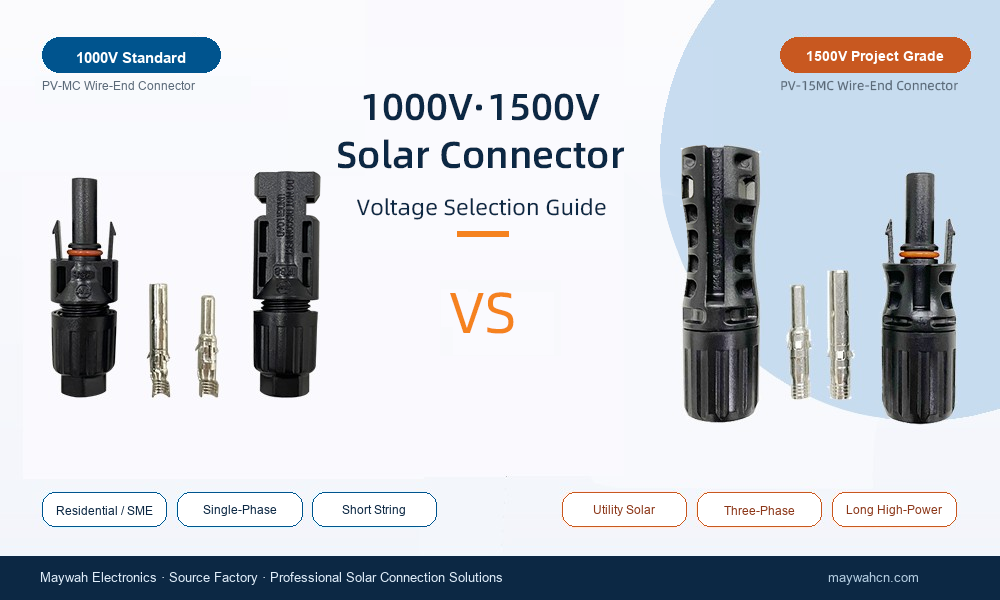
In photovoltaic (PV) system design, the choice of DC-side voltage level is a strategic decision with far-reaching implications. The leap from 1000V to 1500V is not merely a numerical change; it profoundly impacts system architecture, equipment selection, installation costs, and even long-term operational benefits. As one of the most widely used yet most easily overlooked components in PV systems, the MC4 connector's voltage level directly determines the safety and reliability of the entire system.
I. Why are 1500V systems replacing 1000V systems?
Traditional 1000V PV systems have long been the industry mainstream, but with continuous increases in module power and the ongoing expansion of power plant scale, the limitations of 1000V systems have become increasingly apparent. 1500V systems have emerged to address this and have quickly become the new standard for utility-scale projects.
The core advantages of 1500V systems are: Longer strings, allowing for more modules to be connected in series. At a voltage level of 1500V, each string can hold 50% more photovoltaic modules than a 1000V system. This means that for the same power plant capacity, the number of strings is reduced by approximately 30%, and the corresponding amount of auxiliary equipment such as combiner boxes and DC cables is also reduced by approximately 30%.
BOS costs are significantly reduced. Increasing the system voltage from 1000V to 1500V can reduce installation costs by approximately 30%. The demand for BOS components such as couplings, overload safety switch systems, contact circuit breakers, and cables is significantly reduced, and inverters at the 1500V voltage level are more economical. Industry practice data shows that the BOS cost of a 1500V photovoltaic system can be reduced by 5-8% compared to a 1000V system, with the most significant reduction in cable costs, reaching approximately 15%-20%.
System efficiency is improved, and line losses are reduced. At a voltage level of 1500V, DC line losses are reduced, and inverter efficiency is also improved. Higher voltage means less current is needed for the same power output, thus reducing transmission losses. Overall system efficiency can be improved by approximately 2% or more.
II. Fundamental Differences Between 1000V and 1500V MC4 Connectors
The 1500V MC4 connector is not simply a rebranded 1000V connector—the two have fundamental differences in technical specifications and should not be used interchangeably in the same string.
Although the 1500V MC4 connector maintains the same physical dimensions and connection method as the 1000V version, it has undergone a comprehensive upgrade in the following key technical parameters:
Technical Parameters 1000V MC4 Connector 1500V MC4 Connector
Rated Voltage 1000V DC 1500V DC
Rated Current 30A (4-6mm² cable) 30A/50A (4-6mm² cable)
Dielectric Strength Approx. 18kV/mm Over 25kV/mm
Minimum Creepage Distance 8mm 12mm
Protection Rating IP68 IP68
Contact Resistance ≤0.5mΩ ≤0.5mΩ
Insulation System Reinforced. The 1500V connector uses an advanced polymer compound with higher dielectric strength, exceeding 25kV/mm, compared to approximately 18kV/mm for the standard 1000V version, providing superior voltage withstand capability.
Increased creepage distance. The 1500V connector features increased creepage and clearance distances within the housing to prevent leakage under high voltage. The minimum creepage distance for the 1500V design is 12mm, while for the 1000V design it is 8mm. This design is crucial for preventing electrical traces on the insulator surface.
Optimized housing and contacts. The 1500V connector features a reinforced housing wall design, providing additional insulation barrier and mechanical strength. Simultaneously, an enhanced contact spring system provides greater contact pressure to maintain low resistance under thermal cycling and mechanical stress.
III. How to Choose the Right Voltage Rating for Your Project?
The 1000V MC4 connector is suitable for residential rooftop photovoltaic systems and small commercial photovoltaic installations, with a rated current of 30A continuous and a cable gauge of 4-6mm². For smaller systems with string voltages not exceeding 1000V, 1000V connectors are an economical and proven choice.
The 1500V MC4 connector features wider internal creepage and clearance distances to handle the higher string voltages common in utility-scale and large commercial systems, and is available in 30A or 50A models depending on cable size. For applications such as ground-mounted substations, commercial and industrial rooftop arrays, floating PV systems, solar tracking systems, and battery storage systems, the 1500V connector is a better choice.
Exploring higher voltages. Notably, Staubli, the original manufacturer of the MC4, has now launched a 2000V rated connector (“Original MC4-Evo 2000”), combining the standard MC4 contact design with a higher current MC4-Evo 2 housing, and is dually certified by TÜV Rheinland and UL. However, currently, the 2000V connector is primarily geared towards large utility projects, and 1500V remains the practical voltage limit for most inverters and combiner box equipment on the market.
IV. Key Considerations in Selection
- System voltage is limited by the lowest rated component. Using a 2000V connector in a 1500V inverter string offers no benefit—the system voltage remains limited by the lowest rated component in the circuit. Similarly, mixing 1000V connectors in a 1500V system will reduce the overall system voltage to 1000V, posing a serious safety hazard.
- 1000V and 1500V connectors must not be used interchangeably. A 1500V connector is not simply a rebranded 1000V connector; the two should not be used in the same string. The insulation materials, creepage distances, and clearances of connectors of different voltage ratings differ fundamentally; mixing them will lead to insulation failure and safety hazards.
- Certification standards guarantee quality. Qualified photovoltaic connectors should comply with IEC 62852—this standard applies to connectors with a maximum rated voltage of 1500V DC in photovoltaic system DC circuits. Furthermore, UL 6703 certification is crucial for entering the North American market. When purchasing, verify that the product has third-party certifications such as TÜV and UL.
- Pay attention to installation quality. Regardless of the voltage level chosen, correct installation is crucial to ensuring the long-term reliable operation of the connector. Poor crimping, incomplete mating, or loose locking mechanisms can turn even the best connector into a source of system failure.
Conclusion
The voltage upgrade from 1000V to 1500V in photovoltaic (PV) systems not only brings significant economic benefits, such as a 30% reduction in BOS costs and improved system efficiency, but also places higher technical demands on connectors, a critical component. The 1500V MC4 connector, through reinforced insulation materials, increased creepage distance, and optimized housing design, achieves a 50% increase in voltage capability while maintaining the same physical dimensions.
In PV project design, correctly selecting the connector's voltage rating—and ensuring standardization throughout the selection, installation, and maintenance process—is fundamental to guaranteeing the system's safe, efficient, and long-term operation. After all, the number of connectors in a PV system exceeds the number of PV modules; though small, they are crucial to the power plant's lifeline.
 telephone
 Contact US