
A Visual Guide to the International Certification System of MC4 Connectors
I. Why Do MC4 Connectors Require International Certification?
MC4 connectors operate outdoors for extended periods, facing high-voltage DC, strong ultraviolet radiation, rain, temperature differences, wind and sand, and continuous current loads. Incomplete product certification may lead to the following risks:
Import customs clearance or project acceptance may be hindered. The photovoltaic project may fail to meet local safety regulations. The connector's waterproof, flame-retardant, and weather-resistant properties may not meet standards. Overheating, arcing, water ingress, or aging issues may occur during long-term operation. Difficulty in determining liability in the event of after-sales problems. Therefore, international certification is not simply a "qualification demonstration," but a crucial basis for determining whether MC4 connectors are suitable for project applications.
II. Overview of Common International Certification Systems for MC4 Connectors
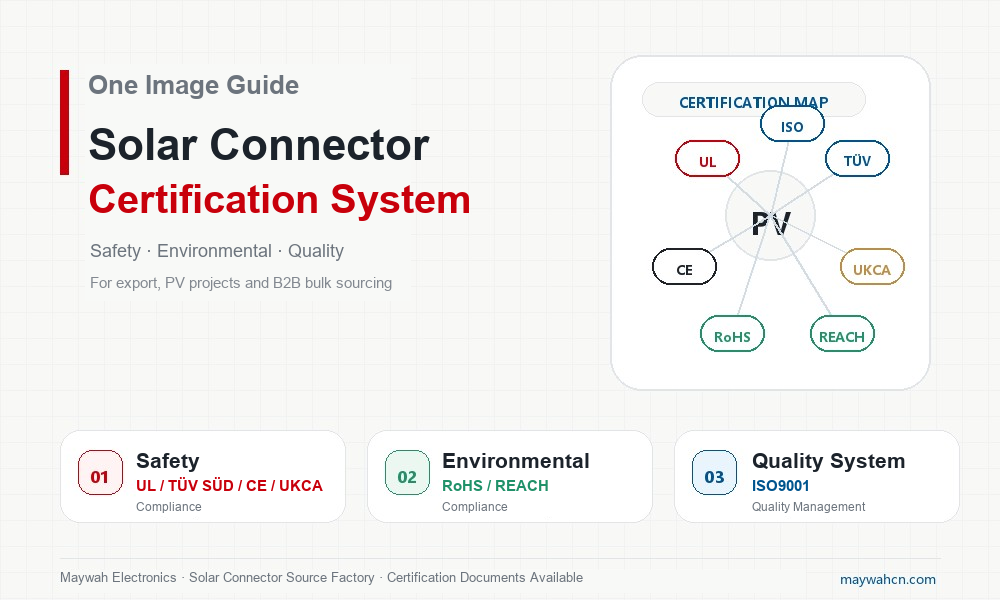
Certification / Standard Main Function Key Applicable Markets Procurement Focus
UL 6703 Photovoltaic Connector Safety Certification USA, North America Does it cover the corresponding model, voltage, and current?
TUV / IEC 62852 International Standard for Photovoltaic DC Connectors Europe and Global Projects Applicable to 1000V/1500V photovoltaic systems?
CE EU Market Compliance Mark EU Does it meet the requirements of relevant EU directives?
RoHS Hazardous Substance Restriction EU, UK, and other markets Does the material meet environmental protection restrictions?
REACH Chemical Safety Compliance EU Does it involve substances of very high concern?
UKCA UK Market Compliance Mark UK Compliance mark required for sales in the UK market.
ISO9001 Quality Management System Certification Global B2B Procurement Does the factory have stable quality management capabilities?
III. UL Certification: A Key Barrier to Entering the North American Market
For MC4 photovoltaic connectors exported to the US, Canada, and other North American markets, UL certification is one of the safety certifications that buyers pay close attention to. The common standard for photovoltaic (PV) connectors is UL 6703, which is primarily used to assess the reliability of PV system connectors in terms of electrical safety, structure, materials, and long-term use.
When purchasing, it is recommended to focus on verifying:
The authenticity and validity of the UL certificate;
Whether the certificate model covers the purchased product;
Whether the rated voltage and current meet project requirements;
Whether the product is suitable for the corresponding PV system scenario;
Whether the supplier can provide complete certification documentation.
For North American customers, UL certification not only relates to procurement trust but may also affect project acceptance and local compliance requirements.
IV. TUV / IEC 62852: Common Certification Basis for European PV Projects
TUV certification is usually related to the international standard IEC 62852, which mainly addresses the safety and performance requirements of DC connectors for PV systems. European customers, PV distributors, EPC contractors, and module manufacturers typically focus on TUV certification.
TUV/IEC 62852 certification typically reflects a product's capabilities in the following areas:
DC high-voltage connection safety
Waterproof, dustproof, and shockproof capabilities
Material weather resistance and mechanical stability
Mating, locking, and contact reliability
Long-term outdoor photovoltaic application compatibility.
For 1000V and 1500V photovoltaic systems, it is essential to confirm that the connector certificate covers the corresponding voltage level during procurement to avoid misusing lower-specification products in high-voltage systems.
V. CE Certification: A Fundamental Compliance Mark for Entering the EU Market
CE is an important compliance mark for products entering the EU market, representing that the product complies with applicable EU regulations and directives. For electrical products such as photovoltaic connectors, CE is usually related to compliance requirements such as safety, electromagnetic compatibility, and environmental protection.
It is important to note that CE is not a single test item, but a compliance mark for EU market access. Customers should not only look for the CE mark during procurement but also further confirm whether the supplier can provide the corresponding declaration of conformity, test data, or supporting documentation.
VI. RoHS Certification: A Crucial Environmental Compliance Requirement
RoHS primarily restricts the use of certain hazardous substances in electrical and electronic products, such as lead, mercury, cadmium, and hexavalent chromium. For exports to the EU, the UK, and other markets that prioritize environmental regulations, RoHS is a very common compliance requirement.
For MC4 connectors, RoHS mainly involves:
Plastic housing materials
Metal terminal materials
Plaque materials
Seals and related accessories
Having RoHS compliance documentation helps customers meet local environmental regulations and enhances product credibility in European and American markets.
VII. REACH Certification: Focus on Material Chemical Safety
REACH is the EU regulation on the registration, evaluation, authorization, and restriction of chemicals, focusing on whether products contain substances of very high concern. For photovoltaic connectors, REACH is typically used to prove that materials and components comply with EU chemical safety requirements.
When procuring, REACH documentation helps customers determine whether suppliers have the basic capabilities in material control, environmental compliance, and export to Europe.
VIII. UKCA Certification: A Compliance Mark for the UK Market
UKCA is a product compliance mark used in the UK market. For photovoltaic connectors exported to the UK market, the UKCA (UK Certificate of Compliance) serves as a crucial basis for product compliance with relevant UK regulations.
If customers primarily sell to or participate in UK photovoltaic projects, it is recommended to verify in advance whether the supplier possesses the relevant UKCA documentation to mitigate subsequent market access and sales compliance risks.
IX. ISO 9001: Assessing Factory Quality Management Capabilities
Unlike product safety certifications, ISO 9001 primarily reflects a company's quality management system capabilities. For B2B bulk purchases, OEM customization, and project-based orders, ISO 9001 helps buyers assess whether a supplier possesses stable production, process control, quality traceability, and continuous improvement capabilities.
When purchasing MC4 connectors, ISO 9001 provides a reliable endorsement from a factory management perspective, making it particularly suitable for long-term clients, distributors, and engineering project purchasers.
X. How to Verify Certification Documents When Purchasing MC4 Connectors?
Before purchasing, it is recommended to carefully verify the following:
Is the certificate valid?
Is the certificate holder consistent with the supplier or manufacturing plant?
Does the certificate model cover the purchased product?
Do the certification parameters cover 1000V or 1500V requirements?
Can a complete PDF file or certificate number be provided?
Are RoHS, REACH, and other environmental protection documents relevant to the current product materials?
Can bulk orders maintain consistent materials and structure with certified samples?
Do they support the technical documents, specifications, and test reports required for project acceptance?
Many purchasing risks are not due to a lack of certification, but rather to "mismatched certificate models," "incomplete parameter coverage," "expired certificates," or "inconsistent certification holders." These details are particularly important in project procurement.
XI. Advantages of Meihua Electronics' MC4 Connector Certification
Meihua Electronics specializes in MC4 photovoltaic connectors and photovoltaic connection solutions, with products covering 1000V/1500V MC4 connectors, board-end connectors, branch connectors, diode connectors, fuse connectors, and photovoltaic wiring harness assemblies.
Meihua photovoltaic connectors possess certifications including UL, TUV, CE, RoHS, REACH, UKCA, and ISO9001. Designed specifically for outdoor photovoltaic applications, their products boast advantages such as IP68 waterproofing, UV resistance, V0 flame retardancy, low contact resistance, and stable conductivity.
For distributors, EPC contractors, installers, and OEM customers, Meihua not only provides standard connectors but also supports customization of specifications, wiring harnesses, logos, packaging, labels, and project-specific solutions. This helps customers reduce procurement risks, improve installation efficiency, and ensure long-term stable system operation.
Conclusion
In conclusion, the certification system for MC4 connectors represents product safety, material compliance, project accessibility, and long-term reliability. For photovoltaic systems, connectors are not merely small accessories but crucial connection nodes affecting the safe operation of the system.
Choosing a fully certified, high-quality, and reliable MC4 connector supplier ensures safer and more secure connections every time.
Meihua Electronics, connecting every ray of sunshine.
 telephone
 Contact US