
Common MC4 Connector Faults and Prevention: 8 Key Issues Explained
Common MC4 Connector Faults and Prevention: 8 Key Issues Explained
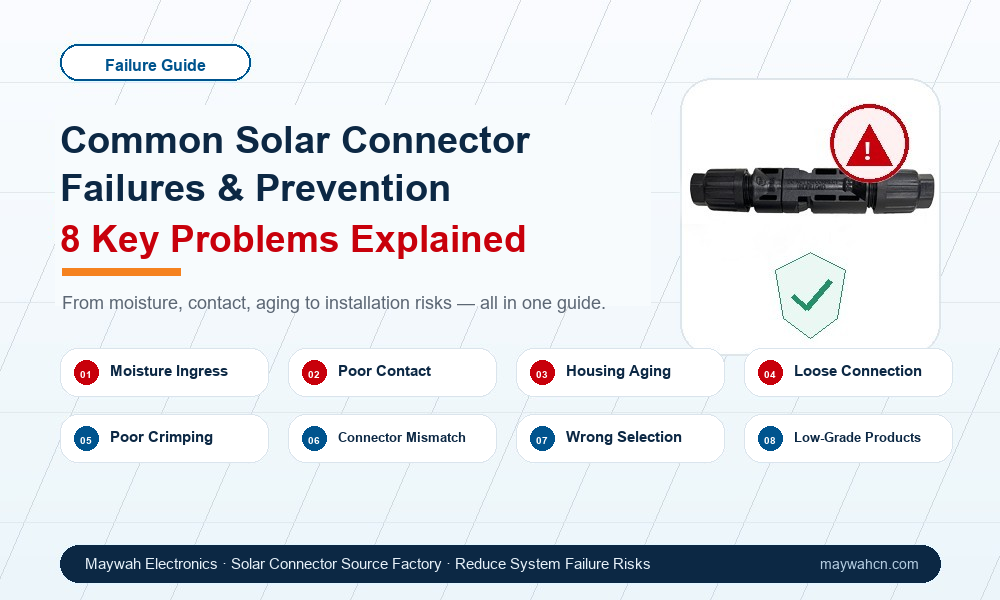
In photovoltaic (PV) systems, the MC4 connector, though a small component, plays a crucial role in connecting PV modules, cables, inverters, and combiner devices. Connector failure can range from affecting power generation efficiency to causing poor contact, overheating, arcing, burnout, or even system shutdown.
For PV power plants, commercial and industrial rooftops, residential PV systems, and energy storage systems, selecting reliable MC4 connectors and ensuring proper installation and maintenance are essential for long-term stable operation. Below, we explain the causes and prevention methods for MC4 connector failures by addressing eight common issues encountered in practical applications.
I. Water Ingress into the Connector
Common Symptoms:
Moisture or water accumulation inside the connector
Oxidation and blackening of metal terminals
Abnormal system insulation
Abnormal power generation or alarms after rain
Main Causes: MC4 connectors are exposed to outdoor environments for extended periods. If the waterproof structure is unstable, the sealing ring is aged, the end cap is not tightened, or the cable specifications are incompatible during installation, rainwater and moisture can easily enter the connector.
Prevention Recommendations:
Choose photovoltaic connectors with an IP68 waterproof rating.
Ensure the end cap is tightened and the sealing ring is properly installed during installation.
Select a connector size that matches the cable's outer diameter.
Avoid prolonged immersion of the connector in water.
Regularly check outdoor connectors for looseness or aging.
II. Poor Contact Leading to Overheating
Common Symptoms:
Abnormally high connector shell temperature.
Deformation, yellowing, or burn marks at the connector.
Unstable photovoltaic string current.
In severe cases, melting may occur.
Main Causes: Poor contact is usually related to terminal quality, crimping process, improper mating, or mixing connectors from different brands. When the contact resistance is too high, current flowing through the connection point will cause an abnormal temperature rise, affecting system safety.
Prevention Recommendations:
* Choose tin-plated copper terminals to ensure stable conductivity.
* Use professional crimping tools to avoid improper crimping, biased crimping, or weak connections.
* Confirm the locking mechanism is in place by sound or feel during mating.
* Avoid mixing connectors of different brands and structures.
* Conduct thermal imaging inspections for key projects.
III. Shell Aging and Cracking
* Common Manifestations:
* Connector surface becomes brittle, whitens, and cracks.
* Clamps break or tail cap is damaged.
* Decreased connector sealing performance.
* Obvious material aging after prolonged exposure to sunlight.
* Main Causes: Photovoltaic connectors are exposed to strong ultraviolet radiation, high temperatures, wind, sand, and rain for extended periods. If the shell material has insufficient UV resistance, it is prone to aging and cracking, thus affecting waterproofing and mechanical strength.
Prevention Recommendations:
* Choose outdoor-grade UV-resistant connectors.
* Pay attention to the flame retardant rating and weather resistance of the housing.
* Avoid using low-cost recycled materials or ordinary plastic products.
* In areas with high temperatures and strong sunlight, choose products with better weather resistance.
* During maintenance, focus on checking the condition of connector housings in exposed areas.
IV. Connector Loosening
* Common Symptoms:
* Loose male/female connector mating.
* Loose connector after slight cable pulling.
* Occasional circuit breaks during system operation.
* Arcing or burning marks at the connection point.
* Main Causes:
* Connector loosening may be due to a weak locking mechanism, incomplete mating, improper installation, or inconsistent connector dimensional accuracy. Loosening leads to unstable electrical connections, increasing the risk of overheating and arcing.
Prevention Recommendations:
* Choose MC4 connectors with a precision locking structure.
* Ensure the male and female terminals are fully engaged during installation.
* Do not force-plug incompatible connectors.
* Secure cables properly in installation environments with high vibration or wind.
* Regularly check connection points for looseness.
V. Poor Crimping
* Common Symptoms:
* Loose connection between terminal and cable.
* Failure to meet tensile test standards.
* Overheating at conductor crimping point.
* Abnormal contact shortly after installation.
* Main Causes:
* MC4 connectors require crimping with photovoltaic cables via terminals. If the crimping tools are unprofessional, the wire stripping length is inappropriate, or the terminal specifications and wire diameter do not match, it can easily lead to incomplete crimping, uneven crimping, damage, or pull-out.
Prevention Recommendations:
* Select appropriate terminal specifications based on wire diameter.
* Use professional photovoltaic terminal crimping tools.
* Control wire stripping length to avoid exposed copper wires or insufficient crimping.
* Conduct sample crimping tests before batch construction.
* Perform random inspections and tensile tests on projects.
VI. Mixing Connectors from Different Brands
Common Symptoms:
* Loose latching after mating.
* Increased contact resistance.
* Reduced waterproofing.
* Overheating, water ingress, or detachment issues later.
Main Causes:
* Although many photovoltaic connectors look similar, differences in size, terminal structure, sealing design, and tolerance control may exist between different brands. Mixing them may cause unstable mechanical fit or electrical contact.
Prevention Recommendations:
* Use connectors of the same brand and series whenever possible within the same string.
* Standardize connector models and specifications during project procurement.
* If compatible replacement is required, conduct mating, pull-out, waterproof, and temperature rise tests beforehand.
* Do not mix and match connectors based solely on appearance.
VII. Current or Voltage Mismatch
* Common Symptoms:
* Connector overheating under prolonged high load.
* Terminal overload damage.
* Connector incompatibility after system upgrade.
* Misuse of low-specification connectors in 1500V systems.
* Main Reasons:
* Different photovoltaic systems have different requirements for the rated voltage and current of connectors. Using inadequately sized connectors in high-voltage, high-current scenarios may affect system safety and lifespan.
Prevention Recommendations:
Select 1000V or 1500V connectors based on the project system.
Check that the connector's rated current meets the requirements of the cable and components.
Prioritize project-level specifications for large power plants and industrial/commercial projects.
Confirm that certification certificates cover the corresponding model and voltage level before purchasing.
VIII. Batch Risks from Low-Priced, Inferior Products
Common Manifestations:
Inconsistent dimensions within the same batch;
Poor insertion/removal feel, easily broken clips;
Unstable terminal plating;
Insufficient waterproof, flame-retardant, and UV-resistant performance;
Concentrated outbreak of after-sales problems after batch installation.
Main Reasons:
Some low-priced connectors may cut corners in housing materials, terminal materials, sealing structures, and quality control to reduce costs. Although the unit price of MC4 connectors is small, the rework and after-sales costs resulting from batch failures far exceed the price difference.
Prevention Recommendations:
* Choose a source manufacturer with stable production capabilities.
* Pay attention to certifications such as UL, TUV, CE, RoHS, and REACH.
* Conduct sample testing before bulk purchases.
* Verify key parameters such as materials, terminals, waterproofing, and flame retardancy.
* For long-term projects, choose suppliers with stable batch production and timely after-sales response.
* How to Choose More Reliable MC4 Connectors?
When purchasing MC4 connectors, don't just look at the price; comprehensively consider product certifications, material performance, structural design, supply capacity, and after-sales service. We recommend focusing on the following key points:
Does it possess core certifications such as UL and TUV?
Does it achieve an IP68 waterproof rating?
Does it use UV-resistant and V0 flame-retardant materials?
Does it use copper-plated tin terminals?
Does it possess low contact resistance and stable conductivity?
Does it support 1000V/1500V system requirements?
Is it from a stable and reliable source manufacturer?
Does it support bulk supply, customization, and technical services?
Meihua Electronics MC4 Connector Solution
Meihua Electronics specializes in photovoltaic connector manufacturing, with products covering MC4 connectors, board-end connectors, branch connectors, diode connectors, fuse connectors, and photovoltaic wiring harness components, meeting the needs of residential photovoltaics, commercial and industrial rooftops, large power plants, photovoltaic energy storage, and OEM/ODM customization.
Our MC4 photovoltaic connectors possess UL, TUV, CE, RoHS, REACH, UKCA, and ISO9001 certifications. Utilizing engineering-grade materials and precision structural design, they offer advantages such as IP68 waterproofing, UV resistance, V0 flame retardancy, low contact resistance, and stable conductivity, helping customers reduce project risks, improve installation efficiency, and ensure the long-term stable operation of photovoltaic systems.
Conclusion
In conclusion, while the MC4 connector may seem like a small component in a photovoltaic (PV) system, it directly impacts the system's safety, efficiency, and long-term reliability. Only by carefully controlling multiple aspects, including product selection, installation specifications, material performance, and supplier quality control, can the risk of failure be reduced and the overall operational quality of the PV project improved.
Choosing a reliable connector adds an extra layer of safety to your PV system.
Meihua Electronics, connecting every ray of sunshine.
 telephone
 Contact US