

Why are more and more inverter and combiner box manufacturers replacing traditional terminals with MC4 connectors?
Why are more and more inverter and combiner box manufacturers replacing traditional terminals with MC4 connectors?
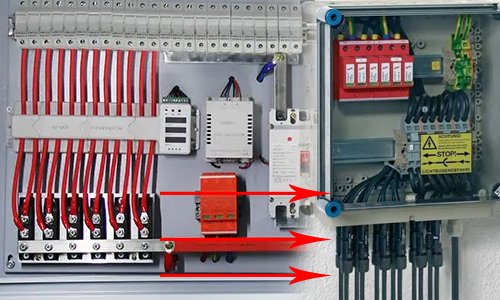
On the DC side of photovoltaic systems, inverters and combiner boxes typically use terminal blocks for their input connectors. However, in recent years, more and more inverter and combiner box manufacturers have been gradually optimizing their products, replacing traditional terminal blocks entirely with MC4 connectors. This is not a simple component upgrade, but a choice made in consideration of safety, efficiency, cost, and industry standards.
First, regarding safety, the structural vulnerabilities of the terminal blocks and the comprehensive protective advantages of the MC4 connector.
Three Major Flaws of Terminal Blocks
1. Loosening and stripping are the most common terminal block failures. Traditional plastic terminal blocks inevitably loosen over time due to thermal expansion and contraction in photovoltaic systems. Even after repeated tightening, stripping can occur. If maintenance is not timely, this can lead to burnout or even fire.
2. Poor contact causing DC arcing. The DC side voltage of photovoltaic systems is typically as high as 600-1000V. Loose connections or poor contact can easily cause DC arcing. Sustained arcing can generate temperatures of 1000-3000℃, which can cause fuses and cables to blow, or even burn out equipment and cause fires. Poor connector operation can increase DC side internal resistance and reduce power generation efficiency, or even cause connector burnout, leading to the burnout of the combiner box and inverter.
3. Insufficient protection level. In outdoor high-humidity and salt spray environments, the insulation performance of terminal blocks deteriorates over time, and their waterproof and dustproof capabilities are far from meeting the 25-year service life requirements of photovoltaic systems. Safety of MC4 Photovoltaic Connectors
The MC4 photovoltaic connector features a self-locking design, ensuring a secure connection that is not easily detached, significantly improving system safety. It boasts an IP68 protection rating, with a housing made of weather-resistant engineering plastic that resists UV radiation and extreme temperature changes. Tin-plated copper terminals provide excellent conductivity and oxidation resistance.
Second, efficiency: From "tightening screws" to "plug and play".
For inverter and combiner box manufacturers, product installation efficiency directly impacts end-user experience and contractor costs.
The installation process for terminals is cumbersome: wire stripping → wire threading → wire wrapping → screw tightening → torque checking. Each connection point requires manual operation, which is not only time-consuming and labor-intensive but also demands a high level of worker skill. In large-scale power plants, tens of thousands of connection points represent a significant investment of manpower. Moreover, terminals are flexible connections, making them inconvenient to secure, leading to frequent loosening and a high failure rate.
In contrast, the MC4 connector uses a push-pull self-locking structure. Simply insert the male and female connectors until a "click" is heard to complete the connection. The MC4 panel connector is easy and quick to assemble, suitable for outdoor operation, and its automatic locking provides a safe connection. This "plug-and-play" design greatly improves installation efficiency.
For inverter and combiner box manufacturers, using the MC4 interface also means that products come with standardized wiring harnesses from the factory. An inverter comes pre-installed with an MC4 input interface. On-site installers simply need to plug the MC4 connector into the photovoltaic string, eliminating the need for any on-site wiring. This not only significantly shortens the on-site installation period but also completely eliminates after-sales issues caused by poor on-site wiring quality—eliminating the risk before the product leaves the factory.
Thirdly, regarding costs: the "cheapness" of the terminals is an illusion.
From a unit price perspective, terminals may seem cheaper. However, end-users consider the overall cost.
Reduced labor costs: The quick-plug feature of MC4 connectors significantly reduces on-site wiring time. Real-world examples show that using MC4 terminals in a DC combiner solution can reduce manual wiring costs by half.
Reduced after-sales and maintenance costs: Loose, stripped, or poorly contacted terminals are common causes of inverter and combiner box failures. MC4 connectors, however, are designed for a lifespan matching that of photovoltaic modules (over 25 years), requiring virtually no maintenance throughout their lifespan.
Reduced hidden losses: Statistics show that among various power plant failures, power generation loss due to connector damage or burnout ranks second. The few dollars saved by using cheaper terminals could be completely lost in a single failure, potentially even resulting in the loss of the inverter or combiner box itself.
 telephone
 Contact US